
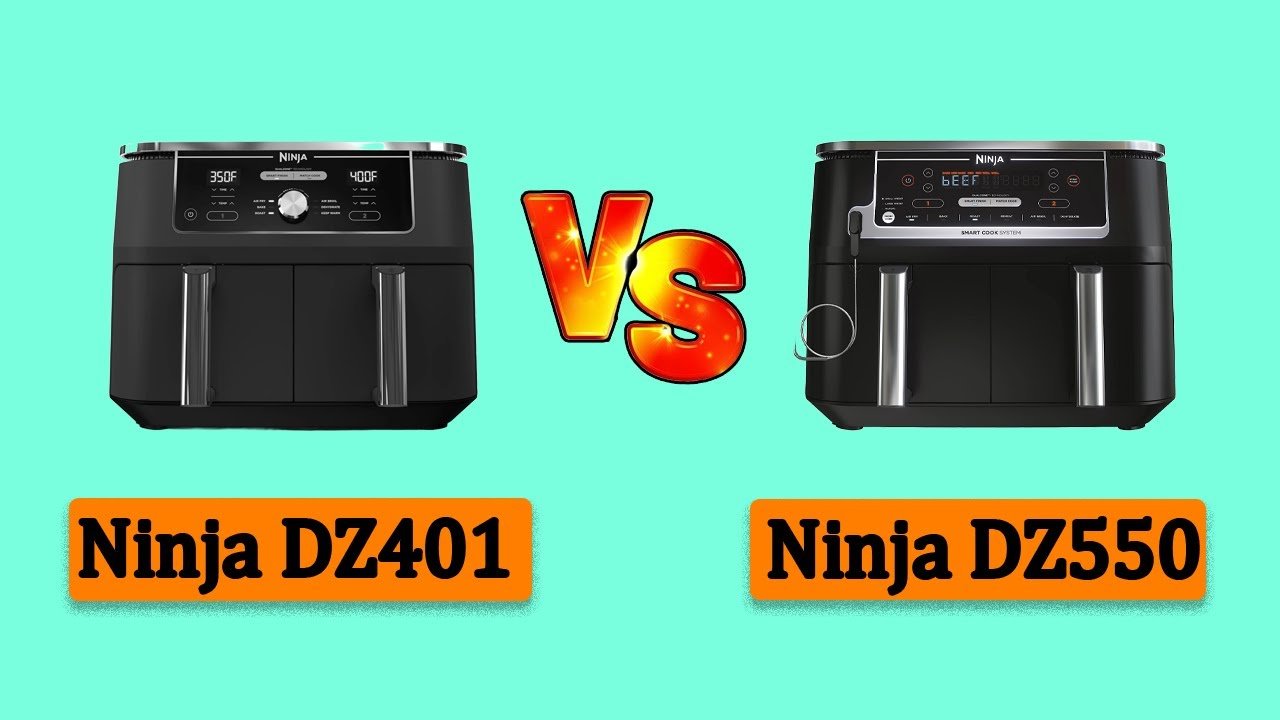
When you’re looking for a capacity-packed, dual-basket air fryer that can substitute for an oven — especially when cooking for a family or meal prepping — the two names most likely to come up are Ninja’s DZ401 and DZ550 models. Both are part of the DualZone XL lineup and promise broad cooking flexibility, generous capacity, and the convenience of cooking two dishes side by side. On the surface, they look nearly identical: two 5-quart baskets (for a total of 10 quarts), similar wattage, and the same core cooking modes.
But if you dig deeper, you’ll find meaningful differences, especially around smart-cooking features, temperature control, and user convenience. These differences can affect how reliably you cook meats, how easily you coordinate multi-dish meals, or how much effort you need to spend babysitting the cooking process.
In this article, we lay out — in plain, user-friendly terms — what the DZ401 and DZ550 share, where they differ, how they perform in real kitchens, and which one is likely to serve you better depending on your cooking style, needs, and budget.
What They Share: Core Features & Capacity
At their core, both DZ401 and DZ550 stem from the same DualZone XL platform. That shared foundation gives them a strong baseline of cooking power and flexibility:
- Dual-Basket Design (2 × 5 qt = 10 qt total): Each unit offers two independent baskets of 5 quarts each. That means you can cook two different dishes at the same time — for instance, chicken in one basket and fries in the other — without mixing flavors or odors. This capacity works great for families, batch cooking, meal prep, or re-heating multiple portions.
- Similar Heating Power, Cooking Speed & Capacity: Both appliances draw significant wattage and heat quickly, giving you oven-like results faster than a conventional oven. Whether you’re frying fries, roasting vegetables, or baking a tray of wings, both models deliver comparable heat and airflow, yielding crisp exteriors and juicy interiors.
- Core Cooking Modes: Air fry, bake, roast, reheat, dehydrate — both models support the same core cooking functions. For many users, those are the modes they rely on 80–90% of the time.
- Clean-Up Ease: Baskets and crisper plates are nonstick and removable, making cleanup manageable. With regular use, both models prove to be dishwasher-safe or simple to wash by hand, helping you avoid lingering grease or stuck-on food.
- Suitable Footprint for Counters & Kitchens: Because the DZ401 and DZ550 share similar dimensions and design layout, installing either on a kitchen counter or storing in a cabinet requires similar space planning.
In short: if your needs revolve around cooking larger meals, prepping multiple dishes at once, reheating leftovers, or cooking batch meals — both units already achieve the essential goal. Their shared foundations make either a solid workhorse for everyday cooking.
What Sets Them Apart: Smart-Cook Features & Temperature Precision
The real difference between the DZ401 and DZ550 appears when you care about precision, timing, and convenience. Here’s how the DZ550 upgrades the basic DualZone experience — and why those upgrades matter:
Built-in Smart Thermometer
- The DZ550 includes a built-in food thermometer (sometimes called the “Foodi Smart Cook thermometer”) that allows you to monitor internal meat temperature while cooking. That means you can target doneness (rare, medium, well done) for steaks, large cuts, or poultry — and stop the cook the instant the target temperature is reached.
- With that thermometer, you don’t need to guess if a roast or whole chicken is done; the fryer alerts you (or you watch/read the display) and get more reliable results, especially for proteins that need precise internal temperature.
The DZ401, by contrast, does not include a thermometer — and if you want to measure internal temperature you’ll need a separate probe or thermometer and manual monitoring.
Automated Cooking Coordination (Dual-Basket Timing)
- The DZ550’s “smart cooking” logic can coordinate two baskets: for instance, if you cook a main dish in one basket and a side in the other, the unit can adjust timing so both finish together or in a predictable order. That saves you from awkward juggling — starting each dish separately and manually tracking doneness.
- For long or multi-stage cooks (like roast-then-finish, or meats with side vegetables), this coordination reduces guesswork and makes cooking more “set it and forget it.”
The DZ401 offers no such coordination logic — managing two dishes at once will require manual timing from you.
Heat Recovery & Temperature Stability
- According to many real-user experiences, the DZ550 tends to maintain basket temperature better after you open it and remove food (for shaking, flipping, or checking). That means better consistency for batch cooking — for example, repeatedly frying batches of fries or wings with minimal temperature drop.
- For elaborate cooking or repeated opening/closing (e.g., checking or stirring meat midway), the DZ550’s better stability and recovery help avoid uneven cooking or soggy results.
On the DZ401, heat recovery works — but some users note that temperature fluctuation can be slightly more pronounced, which may affect results if you open baskets often mid-cook.
Real-World Cooking: Everyday Performance & Use Cases
How do these differences matter in real kitchens? Based on a range of user reviews, test cooking sessions, and anecdotal cooking diaries, here’s how each model fares across common cooking tasks:
Simple meals & batch cooking (fries, wings, veggies, reheats)
- Advantage: Either unit. Because both share core capacity and airflow designs, both deliver crispy fries, roasted veggies, reheated leftovers, and baked snacks reliably.
- User convenience: If you just need to toss in food, set time/temperature, and walk away — the DZ401 is often more than sufficient. You get large capacity, two-basket flexibility, and easy cleaning.
Multi-dish meals (main + side)
- Advantage: DZ550. The ability to coordinate cooking times across baskets matters here. For example, cooking chicken in one basket and veggies or fries in the other — you can have both finish simultaneously. That reduces dish-watching, guesswork, and timing stress.
Cooking proteins (roasts, whole chicken, large cuts, meats)
- Advantage: DZ550 — especially if you care about safe doneness, moisture retention, and avoiding overcooking. The built-in thermometer gives more reliable results and helps you avoid undercooked or overly dry meat.
- On DZ401: You can still cook proteins, but you’ll need to rely on external thermometers or check manually — which often means opening the basket, risking heat loss, and cooking outcomes that are less consistent.
Batch cooking & repeated cooking sessions
- Advantage: DZ550 for consistency; DZ401 for simplicity. Over many meals, cooks who use the fryer several times per week notice that the DZ550 produces more repeatable results, especially for multi-step dishes. But if your use is occasional — say, a few times a month — the DZ401 remains a dependable budget-friendly workhorse.
Overall: the more you cook, the more benefit the DZ550’s automation and built-in thermometer provide. For occasional cooks, the DZ401 often suffices — and keeps things simple and affordable.
Ease of Use, Maintenance & Everyday Kitchen Fit
| Factor | DZ401 | DZ550 |
|---|---|---|
| User Interface & Controls | Simple, straightforward controls — good for users who prefer minimal fuss | Slightly more advanced interface (thermometer readout, cooking coordination) — still user-friendly, but more tech involved |
| Cleaning & Maintenance | Removable baskets and trays — easy to clean | Same removable baskets/trays and easy cleaning; identical upkeep burden |
| Countertop Footprint & Storage | Moderate — fits typical kitchen counters | Same footprint — equally easy to store or place in kitchen |
| Durability & Reliability | Well-built, sturdy construction, straightforward design | Similarly built — plus added electronics (thermometer/sensors) that may require slightly more care but no widespread reliability complaints |
In day-to-day operation, both models share the same ease of cleaning and maintenance. If you want a “set it and forget it” device, the DZ550 makes that easier. If you prefer something straightforward and predictable — especially for simpler cooking — the DZ401 is arguably simpler to integrate into the kitchen routine.
Value & Cost Considerations
Because both units share much of the same hardware (heating elements, basket size, core cooking modes), the price premium for the DZ550 reflects convenience and added features — not raw cooking power.
Here’s how to decide based on value:
- If your cooking is simple, occasional, or you mostly do frying, baking, reheating, vegetables, or small batches: The DZ401 delivers the essentials for less money. Since you won’t often use the thermometer or basket coordination, the extra cost for those features may not pay off.
- If you cook frequently — especially proteins, multi-dish meals, multi-step recipes, or batch-cook for storage — or you value convenience, precision, and repeatability: The DZ550 often justifies the added cost. The thermometer and smart cooking features may pay for themselves in saved time, less monitoring, and more consistent results over time.
- Long-term flexibility: If you foresee cooking habits shifting — for example, deciding later to cook more steaks, roasts, big family dinners — the DZ550 gives you head-room. If you know you’ll stick to simpler meals, the DZ401 gives better cost-to-objective value.
In simple terms: you pay more for intelligence and convenience. The question is: will you use those extras often enough for them to matter?
Who Each Model Serves Best
- Choose the DZ401 if:
- You mostly cook simple meals — fries, veggies, reheats, snacks.
- Budget matters, and you prefer to pay only for what you need.
- You want straightforward, consistent cooking with minimal overhead.
- You cook occasionally, not several times a week.
- Choose the DZ550 if:
- You roast meats, large cuts, or cook multi-dish or multi-step meals frequently.
- You want internal-temperature precision (especially for proteins) without buying a separate thermometer.
- You appreciate convenience — automated cook coordination, “set it and forget it,” consistent results.
- You cook often enough that improved consistency, less monitoring, and easier timing coordination matter.
In many households, the DZ550 transforms a DualZone fryer from a simple “fryer or reheater” into a near-mini-oven/roaster with automation. For people who cook regularly and value their time and results, that difference becomes highly significant.
Limitations & What to Check Before Buying
Even the better model has limits. Before you pick either fryer, be aware of:
- Basket capacity constraints: While two 5-quart baskets are generous for many meals, extremely large cuts or whole roasts may still be tight — and may require cooking in parts or overtime. Dual-zone cooking is powerful, but not unlimited.
- Learning curve for “smart cooking”: If you’re not used to cooking with temperature probes or coordinating multi-dish cooking, the DZ550’s advanced features take a bit of learning. Mistakes (wrong probe placement, overcrowding baskets) can reduce the benefit.
- Power and outlet requirements: These fryers draw substantial wattage; ensure you have a suitable electrical outlet and that your circuit can handle the load safely.
- Island/storage space/storing baskets: Because the units are large, you’ll need enough counter or storage space; storing two baskets plus trays takes real space.
- Reliance on electricity and no backup for power outages: Unlike gas ovens or stovetop cooking, these fryers rely entirely on electricity — meaning a power failure mid-cook can ruin the meal.
Before buying, consider how you plan to use it — what kinds of meals, how often, space availability, and cooking habits. That will determine which model is genuinely better for you.
Read More: Dowsstrike2045 Python: What You Need to Know
Conclusion
Both the Ninja DZ401 and DZ550 bring powerful, flexible, dual-basket cooking to the kitchen, offering significant benefits over traditional ovens or single-basket fryers — especially in capacity, cooking speed, and convenience for large or multi-item meals. If your cooking is simple, occasional, or heavily oriented toward reheating, baking, or batch-frying, the DZ401 delivers excellent value with minimal fuss.
But when your cooking demands include roasting meats, coordinating multiple dishes, or aiming for precise doneness and timing, the DZ550’s smart thermometer and cooking coordination features often justify the extra cost. In short: for straightforward, everyday cooking, the DZ401 is a dependable workhorse; for more ambitious cooking or regular meal prep, the DZ550 transforms the DualZone fryer into a more precise, convenient, and reliable kitchen ally. Choose based on how you cook — not just on what you expect to cook once in a while.
5 FAQs
Which model is better for occasional cooking versus frequent meal prep?
For occasional cooking (snacks, reheating, small meals), the DZ401 offers great value and simplicity. For frequent cooking — especially involving meats, large meals, or multi-dish cooking — the DZ550’s smart features make it more flexible, precise, and convenient.
What is the main functional difference between DZ401 and DZ550?
The DZ550 includes a built-in food thermometer and smart cooking coordination that monitors internal meat temperature and synchronizes two-basket cooking. The DZ401 lacks those features — you’d need manual monitoring for temperature and timing.
Can I cook two dishes at the same time on both models?
Yes. Both have two independent baskets (5 quarts each) that allow you to cook two different dishes simultaneously, making them ideal for meals with main and side or batch cooking multiple items.
Does the DZ550 cook food faster than the DZ401?
Not necessarily faster — both share similar heating capacity. The benefit of the DZ550 lies in better temperature control and cooking coordination, leading to more consistent results rather than shorter cook times.
Is cleaning difficult on either air fryer?
No. Both models have removable, nonstick baskets and trays that are easy to clean — many people clean them in a dishwasher or by hand with minimal effort.